In Praise of Benidorm, Unexpectedly Enough
By Matthew Clapham.
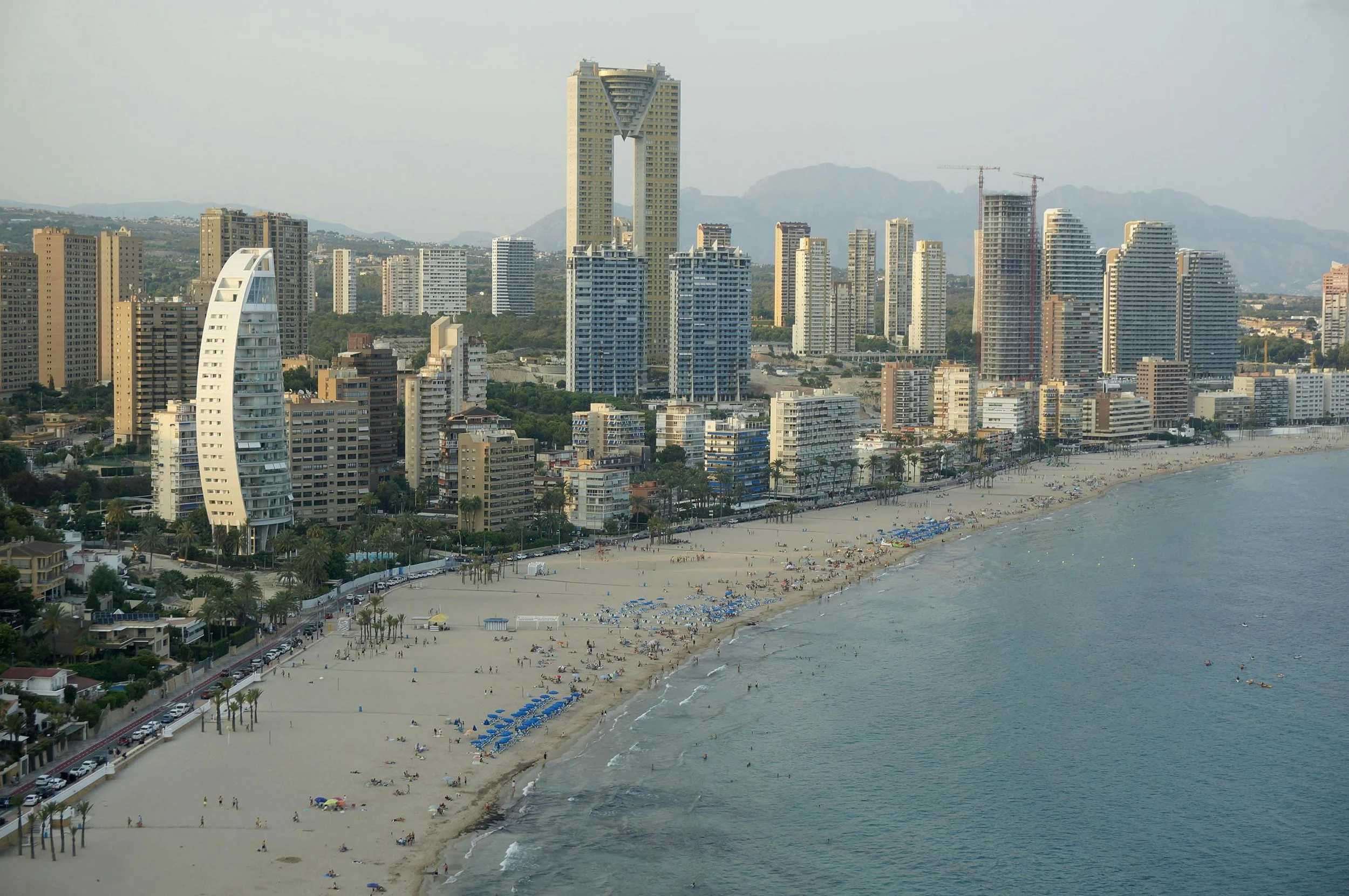
I never imagined I would end up visiting Benidorm. It was only ever a blotch of grey slabs by day, gaudy lights by night, that I drove past along the AP-7, perhaps subconsciously pressing down on the accelerator to leave the disreputable resort in my rear-view mirror.
Much less did I see myself living there, or at any rate a neighbouring village in its Costa Blanca hinterland, let alone writing a book about the place. But life is full of surprises, and so, it turns out, is Benidorm. The low-rent bucket shop destination has a much more nuanced tale to tell than the short shrift we tend to give it.
What is Benidorm?
My first forays into the heart of the city came of necessity when I relocated nearby. The Social Security and tax offices for the area were there. So were the health centre and the office furniture shop. You could – and I did – spend whole days on the streets of Benidorm in tedious personal admin, without even a glimpse of karaoke bars, kebabs or kiss-me-quick hats (or rather their 21st-century equivalent of bawdy ‘Good Girls Go to Heaven – Bad Girls Go to Benidorm’ T-shirts).
It was only by experiencing the humdrum ordinariness of the city as the administrative and economic hub of the Marina Baixa region, that I realised how absurdly one-dimensional my image of Benidorm had been. So I set out to learn a little more about the history of its development, how a poverty-stricken, ramshackle fishing village of barely 2,000 souls in the 1950s, had within a couple of decades become home on any given August Sunday to nearly half a million holidaymakers.
Myths, ancient and modern
A dive into local history revealed tales of medieval knights, and their historical or more mythological deeds. El Cid played a (documented) role in the district’s history, while Roland, Charlemagne’s Frankish knight with his own epic poem, supposedly had a more unlikely hand in reshaping its mountains and Benidorm Island with a blow of his mighty sword Durandal, while defeating a giant and/or saving a damsel.
The mythmaker of modern Benidorm, though, the figure who forged its larger-than-life reputation and loftier-than-Madrid architecture, was the mayor in charge as Franco turned to foreign hard currency from tourism to shore up Spain’s faltering economy, and win some European hearts and minds along the way – if only for a week of welcome sunshine.
Benidorm’s head start in the race to spearhead this new economic sector was – according to Mayor Pedro Zaragoza Orts – the result of his bold solo trip to Madrid astride his trusty Vespa, to convince Franco to allow bikinis to be worn on his town’s beaches, despite threats of excommunication from the local bishop.
And the equally bold decision to allow high-rise development, packing affordable accommodation into a postage stamp of land right by the beach: the grey skyscraper model I had always turned my nose up at. But Pedro Zaragoza and Benidorm had a knack for backing a winner.
The OG 15-minute city
Fast forward half a century, and tourism – in Spain and elsewhere – is booming itself into a social and environmental bust. From Barcelona to Malaga, the Balearics to the Canaries, the housing sector has been cannibalised by tourist flats, while summer populations, along with their swimming pools and golf courses, regularly bring water resources to breaking point (despite the unprecedented deluges of this past winter).
Brutalist Benidorm, meanwhile, is now sitting pretty. Compact, resource-efficient, fully accessible on foot or by electric micromobility, and with less real estate pressure thanks to its vertical capacity. Urban planners are now looking at the ugly duckling, and finding it far more attractive than the elegant – but insanely resource-hungry – whitewashed villas and lush 18-hole golf courses of other destinations.
I found myself reappraising the city and what it means as well, and ended up writing that unexpected book to retell its story from a different perspective
And remember...…
Looking Down on Benidorm will be published by Ybernia in June.
In the meantime, you can find more stories on our podcast and in our shop.