
Kitchen Confidential: 25 Years of Being a Classic
‘Your body is a not a temple, it’s an amusement park. Enjoy the ride.’
Plating food is the final step in the preparation of a meal, the culinary mise-en-scène that makes it appetizing, an experience. With that in mind, hats off to Bloomsbury for producing a book worthy of celebrating both author Anthony Bourdain and the fact that his first non-fiction book, Kitchen Confidential, has been on the shelves for a quarter of a century.
The inside covers and opening pages have winks and nods that capture the spirit of the man, the kinetic energy of the writer, and it’s all set up nicely by an intro from Irvine Welsh. The Scottish author of Trainspotting never met Bourdain, but their books have the same wildness, and their biographies hint at them being kindred spirits.
Bourdain obviously contributed massively to the vibe of the original book, which remains in this latest edition. Sections divided between courses and then coffee and cigarettes, and chapters titled FOOD IS SEX and BIGFOOT catch the eye like an attractive menu in the window of a luxurious restaurant. You stop, stare, and dive right in.
The meat of it
Given that this book is about restaurants, it’s obvious that we learn about how Bourdain cooks, what he cooks, and how he fell in love with food in the first place, as a competitive brat on a French holiday with his parents. If you want to learn what knives to use, how to add sauce to dishes served at your dinner parties, or about the general precariousness of the restaurant industry in general, it’s all here.
Yet the book is really about people and the duality of managing. Sustained a bad injury while cooking? Go to the hospital and come straight back. Never miss a shift. Despite being a demanding boss, though, he often went to bat for his employees by protecting them from restaurant owners, and since most of his workers were Latin American, he took time to learn Spanish and understand their cultures. He admired their work ethic as well, believing that American cooks were work-shy and spoilt. What’s more, Bourdain had to contend with a troubled bread maker who, in the midst of the chaos he created, made the best bread rolls in the world. And as much as he loved his staff and they loved him, he had spies gathering information from waiters to top-level management, and he massaged and shaped situations from afar like a Machiavellian puppet master in a white hat.
We also learn that, in his early years, Bourdain bounced around random establishments. He battled demons and substance abuse on his non-linear rise to the top, confronting bizarre situations like trying to secretly dispose of a Christmas tree he had left up for most of the year, bungling an interview by inadvertently suggesting he knew nothing about meat, and while in mafia-run kitchens, buying bread from the trunks of cars in carpark deals reminiscent of something you’d see on The Wire. Yet he always had an aura, a genius, a talent. Many of his cooks followed him on his job-hopping, and we can assume he led through both his cooking skill and force of personality. At any rate, his ups and downs are as compelling as they are inspiring throughout the book and underscored by the tragedy of what happened after.
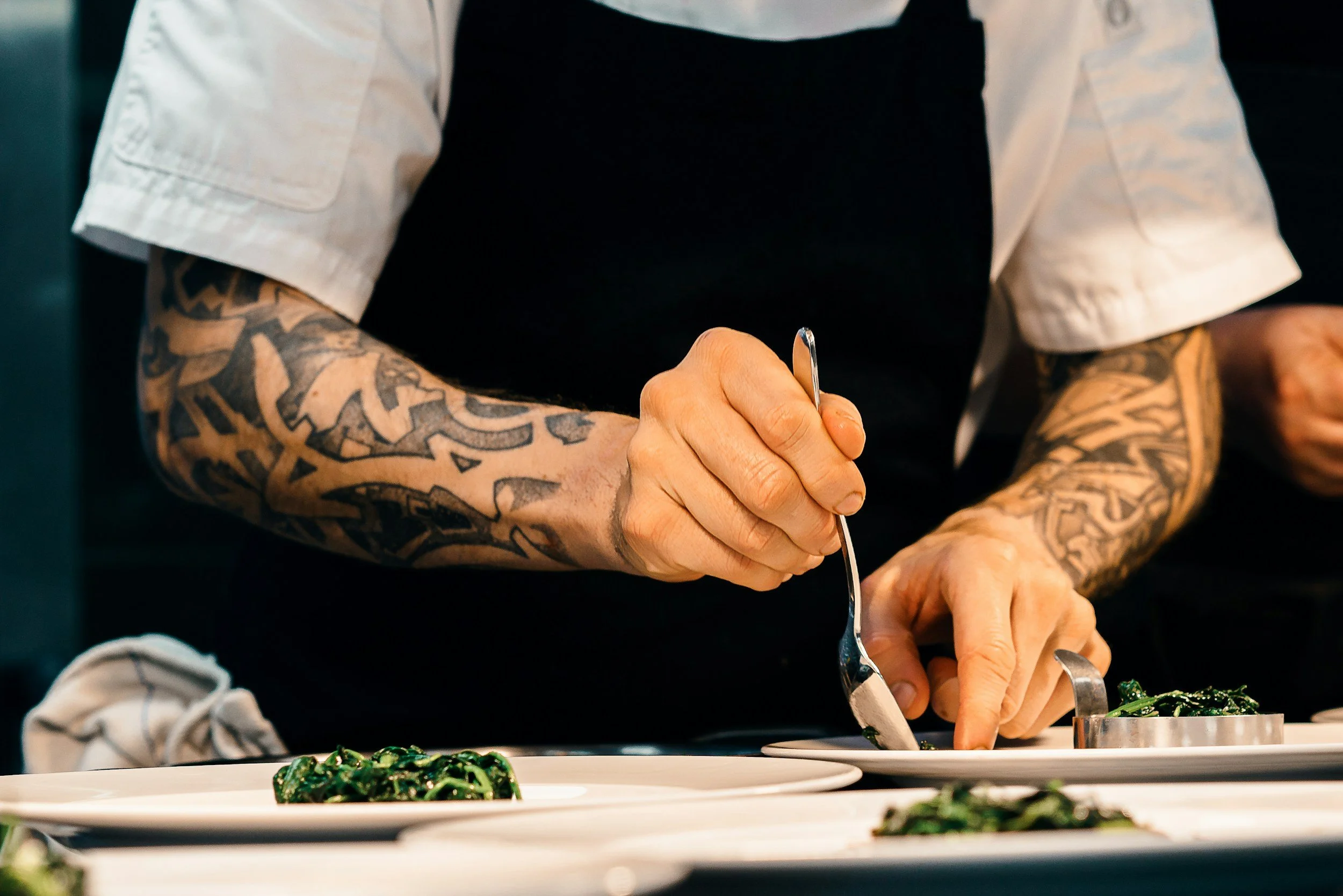
Photo Credit: Sebastian Coman Photography @ Unsplash.com
Second helpings
Kitchen Confidential shares something with Don Quijote. Hell, you could even go as far and say it has a commonality with Ulysses. The book contains trace elements of repetition and self-indulgence, with the former linking it to the Spanish classic, and the latter, apart from being on-brand, connecting the memoir to Joyce’s dense classic.
There are points in the book where another reference is made to the band of pirates that man kitchens, the chaos, the tricks and depravity. The call backs make sense. After all, it’s the intense day-in/day-out of a chef. The gruelling schedule becomes the throughline of one’s career and, on occasion, book. But for the reader, the effect is vitiated slightly with each retelling, losing its flavour like the reheated specials that are doled out during slow Sunday brunches.
The indulgence comes from the lack of tighter editing, the kind that permits such episodes to repeat. Yet, given the tough nature of the work, perhaps it’s no bad thing to bear witness more than once to the fine people who cook for all of us. Being in a kitchen, it seems, is not a job, it’s a vocation, a way of life.
Cheque, please
The playfulness of Kitchen Confidential is found in the final section, with the style of essay varying from a commencement speech to a love letter to another chef. And his stint in Japan is the choice morsel in this particular course.
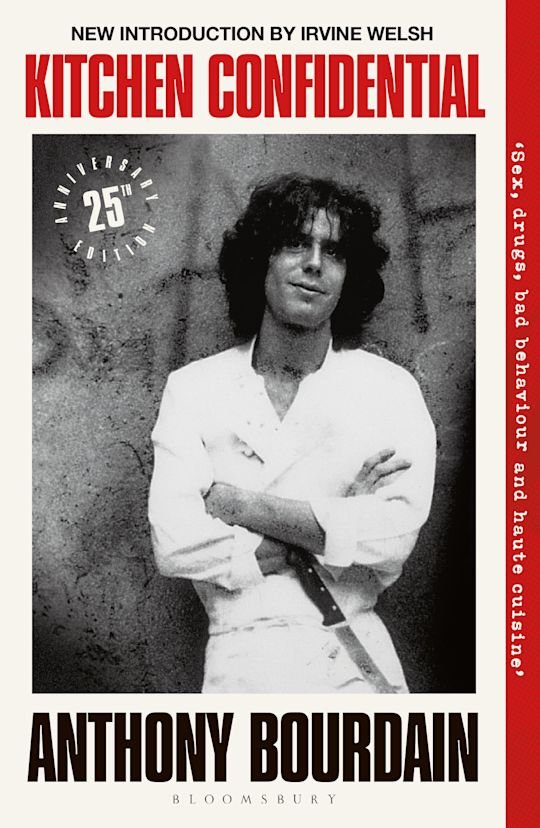
The 25th anniversary edition is published by Bloomsbury.
The obvious beats are compelling, acting as fan service for the general reader who, more often than not, is some degree of Japanophile. His adventures in izakayas (居酒屋) and on the subway, his brushes with punks and crowded street crossings will excite. And there are surprises. In Japan, people get books signed for deceased family members, and in the kitchen, fish is the supreme ingredient and things that are cheap to source in New York are prohibitively expensive in Tokyo. The latter may seem a mundane detail, but it speaks to an artist having to adapt their technique, of having to alter their tools.
Overall, Bourdain invites you on a wild ride, and he’s excellent company throughout. He’s thoughtful, cultured, and knew that the only place to drink a Guinness was Dublin. I had pending the reading of this classic, and now that I am on the side of it, I am grateful that the book has lived up to the fanfare.
And remember…
You can check out our books here, and our podcast by following this link.